
A busy week isn’t always progress
A weekly review is useful when it helps you see whether your days are serving something you care about—and choose what deserves attention next. A longer list of completed tasks may not answer that question.
In an October 2026 r/getdisciplined discussion, someone asked how to make their weekly review more useful than a list of things done. They already looked at fitness, work or study, spending, learning and things they had put off. What they wanted to know was whether the week matched their longer-term goals, without creating a huge checklist.
This is a public self-report, not a customer case or a measured result. It gives us a clear question to work with: how do you connect the record of a week to the direction you want your life to take?

Borrow the part of GTD that brings you back to your commitments
David Allen’s GTD Weekly Review asks you to revisit projects, goals and outcomes, and make sure each has a current action. It also includes reviewing completed actions, waiting items and commitments you may no longer want to pursue.
The useful idea here is to reconnect your lists with your choices. Start with one goal that matters now. Look at the week’s notes, tasks and calendar, then ask: what happened in relation to that goal? You can expand the review later if it helps; you do not need a comprehensive dashboard before having an honest look at one commitment.
If there is no obvious next action, work out why. You may need information, help, recovery time, a smaller commitment, or a decision to stop. Adding more tasks before understanding the constraint can leave the same problem waiting for you next Friday.
Look for small progress on work that means something to you
Teresa Amabile and Steven Kramer’s progress principle offers another useful lens. Their research drew on roughly 12,000 diaries from 238 employees at seven companies. As Harvard Business School’s account explains, progress in meaningful work—even small steps—was closely connected with better emotions, motivation and perceptions of the workday.
This was research about people at work, not a trial of AI weekly reviews. It does not say that checking more boxes guarantees satisfaction. The distinction worth carrying into your review is between being active and moving something meaningful forward.
Bring a piece of the work into view: a change you tested, an explanation you wrote, a decision with its reasons. Ask what it now makes possible. Necessary maintenance and exploration belong here too; describe their contribution honestly rather than inventing a shipping milestone.
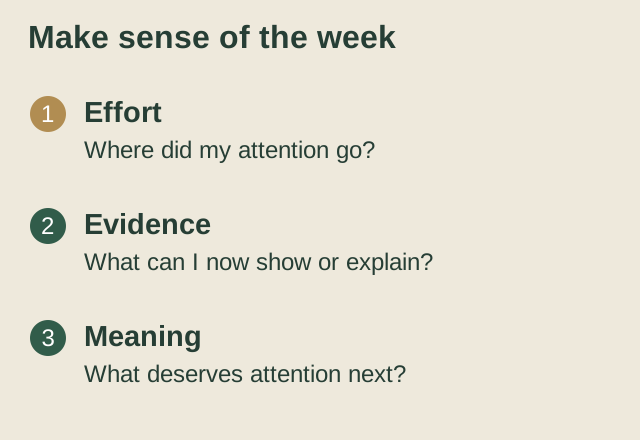
Recorded focus can help you remember where you invested attention. A task marked complete tells you what you chose to close. A work artifact helps you inspect what changed. Keep them alongside one another: hours alone cannot establish an achievement, and an unfinished task does not explain whether you learned something or became blocked.
Ask your agent to help inspect the evidence
An agent can organize dated notes, compare them with a goal and point out gaps. Give it the review period, the goal you want to examine, and only the records or artifacts you intend to share. If you have a focus export, include its generation time and time zone. If you only have notes, start there.
Help me review the period I specify. Separate recorded effort, tasks I marked complete, and changes supported by the attached work. Cite the source for each claim. Identify gaps and ask what matters to me before suggesting a next action. Do not infer achievement from hours or activity.
Then check its answer against the sources. Does it use the right dates? Is it counting the same time twice? Has it treated a missing record as zero, a completion mark as a completion timestamp, or an old snapshot as current? A fluent summary is still something to review.
Let the agent help with arrangement and questions. Keep the judgment about meaning with you: whether a goal still matters, what a setback felt like, whether you need help, and what you are prepared to commit to next. More context is useful only if it serves that conversation.
Finish with a choice you can live with

Write three short answers before closing the review:
- What moved? One change or understanding you can support with evidence.
- What remains? An open question, a constraint or something you need from another person.
- What matters next? One action, a revised commitment or a deliberate stopping point.
You can also note how the week felt. Satisfaction, frustration and immersion say something about your experience that a time total does not capture. You do not need to turn those feelings into a score or prove that every difficult week produced a visible win.
The Reddit author’s question was about alignment with longer-term goals. Return to your own version of that question. Does the next commitment serve a direction you still choose, and is there enough room in your life to give it attention?
When you have chosen, use one concrete next action and a place to resume to make the next session easier to start. If you want the file-sharing steps, the Agent reading guide covers Vibedoro’s optional manual export separately.