How to stay focused when coding with AI
Getting code faster can still leave you feeling further from the work. The useful question is how to keep your own train of thought while an agent is doing part of the execution.
In a July 2026 r/ClaudeCode discussion, a developer described opening YouTube, Reddit or Slack while Claude worked, then needing time to get back into the code when it finished. They felt faster at shipping features but less able to stay immersed. Their question was how to remain with the project through the waiting gaps.
The discussion names a problem worth taking seriously: the next output can be ready before you are ready to think about it.

Turn the goal into a next action you can actually start
David Allen’s Getting Things Done method makes a useful distinction: a project is an outcome that takes multiple steps; a next action is a concrete, visible step. In ordinary language, you should be able to tell what to do when you open your laptop, without planning the project again.
Try rewriting “improve signup” as “retry signup after interrupting the request, and write down what happens to the entered details.” This is a suggested way to phrase a task, not something the Reddit author reported doing. It gives you a question to answer and a result to inspect.
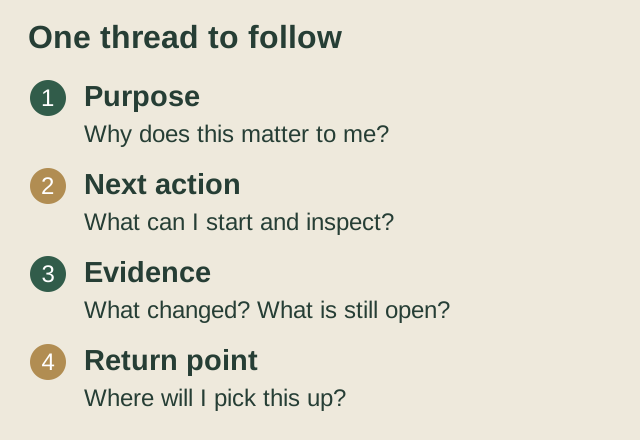
Keep the larger purpose nearby. Why does that check matter to someone using the product? What would you need to see before trusting the result? The next action gives you a starting point; your goal helps you decide whether it is worth doing.
Keep the waiting gap inside the same question—or take a real break
With a question in view, waiting does not have to become another stream of prompts. You can read the relevant code, prepare the check you will run, or write down what you still do not understand. Choose something that belongs to the same question and does not conflict with the agent’s edits.
You can also step away. The aim is not to fill every pause with work. If you want a break, take it deliberately, rather than relying on a feed to decide how long you are gone. When the agent returns a result, finish your current thought before deciding whether to inspect it now.
Researcher Sophie Leroy calls the pull of a previous, unfinished task attention residue: some of your attention stays with that task after you switch. It helps explain why changing the window does not necessarily change what occupies your mind. Leave a clear return point before switching, so you can pick up the question and move the work forward.
Leave a place to resume before switching away
Leroy and Theresa Glomb’s 2018 research tested a “ready-to-resume” plan: briefly note where you stopped and how you will continue. In their studies, this reduced attention residue and helped performance on the interrupting task. They did not test whether it improved performance on the original task after returning, or study AI coding. The university’s account of the research explains those boundaries.

For your own work, try a short note with three parts:
- Where I stopped: the question or check currently in front of you.
- What I know: an observation, with the file, test or note that supports it.
- Where I will resume: one action you can start without reconstructing the session.
Write this for yourself first. You may also share it with your agent so the next conversation starts from the same place. A clear instruction to an agent and a clear return point for a person serve different needs; a long conversation history does not automatically provide both.
Look for a useful change, not a perfect feeling
After the next stretch of work, ask what you can now show, explain or decide. A reproduced failure or a clearer question can be useful even when a feature remains unfinished. If nothing became clearer, inspect what blocked you before launching another round of prompts.
A Pomodoro timer can give the attempt a boundary and remind you to pause. It cannot determine whether the code is correct, whether you understood it, or whether this was the work you wanted to do. Use a length that fits the attempt; do not turn staying focused into an obligation to keep working.